
Understand what makes a candid photo compelling
A strong candid photograph feels discovered rather than arranged. It gives you a glimpse of something real: a private laugh, a thoughtful pause, or two people moving through an ordinary place together. The scene does not need to be dramatic to matter; small gestures often carry the most warmth. Your role is to notice what is already happening and give it enough attention to become a visual story.
Authenticity versus staged spontaneity
Candid photography works best when people are not performing for the camera. That does not mean you must hide or photograph from a distance. It means you avoid directing every hand, smile, and glance, allowing the subject to remain involved in whatever they were doing before you arrived.
There is a useful difference between inviting someone to continue naturally and asking them to recreate a moment. If a friend is making coffee, you might wait for the familiar rhythm of reaching, pouring, and tasting rather than asking for a casual-looking pose. Observation comes before intervention, especially when the ordinary details are what make the image believable.
A staged photograph can still be honest and enjoyable, but it belongs to a different visual language. For a candid frame, look for the unguarded expression that appears between posed smiles, or the slight imperfection that shows the scene was not rehearsed.
Emotion, movement, and meaningful interactions
Emotion in a candid image is not limited to a broad smile. Concentration, hesitation, affection, surprise, tiredness, and amusement can all give a photograph its pull. Watch how people respond to one another, because the relationship between two gestures may say more than either face on its own.
Movement helps you anticipate these connections. A person leaning into conversation, a child turning towards a parent, or a commuter adjusting a bag can create a brief sequence of visual possibilities. Rather than pressing the shutter at the first recognisable expression, stay alert for the moment when posture, gesture, and feeling align.
You can also photograph the aftermath of emotion. The quiet moment after laughter or the pause following a greeting may be less obvious, but it often feels more intimate. Let the image contain some uncertainty; viewers enjoy having room to wonder what happened just before the frame.
The role of context and background
A face alone can show feeling, but the surroundings tell you where that feeling belongs. A tram stop, corner shop, laneway, beach path, or shaded park can turn a portrait into a sense of place. Look for details that support the subject without competing with them.
Backgrounds deserve the same attention as people. Bright signs, poles, bins, and unrelated faces can pull the eye away, while repeating shapes, soft colour, or open space can give the subject breathing room. Before you take the photograph, make a quick scan around the edges of the frame and decide whether each major element helps the story.
Context should not become clutter. If the setting is visually busy, move a step, change your angle, or wait for a cleaner arrangement. Sometimes a small shift is enough to connect the person with the city while keeping the photograph easy to read.
How timing creates visual storytelling
Timing is the craft of recognising when separate parts of a scene briefly make sense together. A cyclist passing a patch of light, two strangers sharing a glance, or a hand reaching into the frame can create a beginning, middle, and implied ending in a single image. You are not simply recording movement; you are choosing the instant that lets the viewer imagine more.
Try watching a scene for a while before photographing it. Notice its rhythm and identify what tends to repeat. At a busy crossing, for example, the interesting moment may arrive when one person pauses while everyone else continues around them.
Keep your camera ready, but do not rush every frame. A candid image often improves when you wait for the gesture to complete rather than capturing the first sign that something is happening. That patience gives the photograph a clearer emotional centre.
Choose the right camera settings
Your settings should remove technical hesitation without taking your attention away from the scene. Phone cameras are well suited to candid work because they are light, familiar, and quick to raise, but you still need to understand how they respond to movement and low light. If you use a dedicated camera, keep the controls simple enough to operate without staring at them. Aim for a reliable exposure first, then refine the look when the conditions allow it.
Selecting shutter speeds for moving subjects
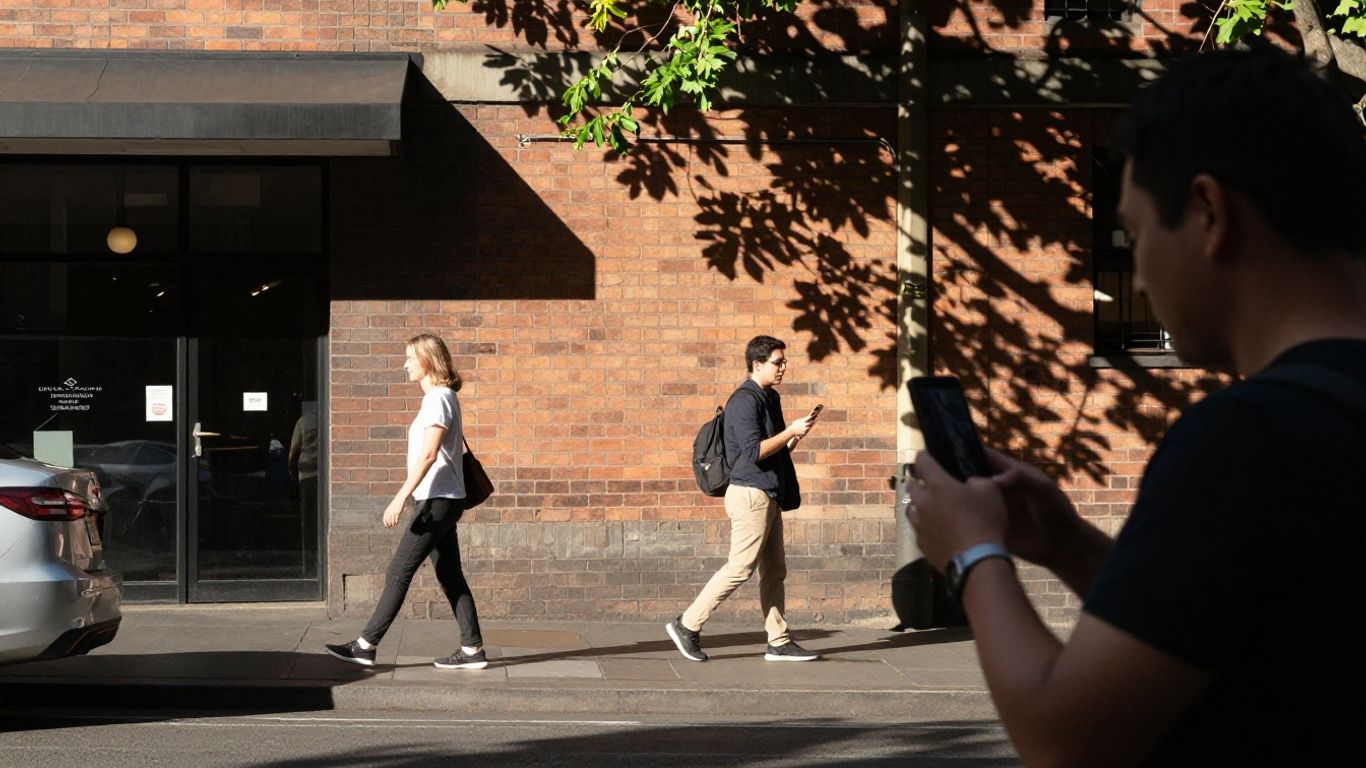
Movement is often the first technical problem in candid photography. If your subject is walking, turning, or gesturing, a slow shutter speed can blur the detail you wanted to preserve. On a phone, tap to focus and hold your position as steadily as possible; use any motion or action setting available when the scene is changing quickly.
With a dedicated camera, begin with a shutter speed that is fast enough for the movement in front of you, then adjust after reviewing a few frames. A person standing still needs less speed than a runner, but even a quiet conversation includes small hand and head movements. Image stabilisation can help with your own movement, yet it will not freeze a subject who is moving through the frame.
Do not treat a little blur as an automatic failure. A blurred hand or passing figure can communicate energy, provided the main visual idea remains clear. Decide whether you want to freeze the moment or let movement become part of its character.
Using aperture to control attention
Aperture affects how much of a scene appears sharp and how much attention falls on the subject. A wide aperture can soften a distracting background, while a narrower aperture keeps more of the street or room recognisable. Phones often create this effect computationally, so inspect the edges of portrait-mode blur for signs that the separation looks unnatural.
The right choice depends on the story. If a person’s relationship with a particular place matters, retain enough detail to identify the setting. If the surroundings are chaotic, a softer background may help the expression carry the frame.
A shallow focus effect is not a substitute for composition. Move your feet first, simplify the background where possible, and use aperture to support that decision rather than rescue a crowded photograph.
Balancing ISO and image quality
Low light can tempt you to raise sensitivity quickly, but excessive image noise may soften faces and erase small details. Phones make these decisions automatically, so look for brighter areas, face your subject towards available light, and avoid digital zoom when the scene is already dim.
On a camera with manual controls, raise ISO only as far as needed to keep the shutter speed useful. A slightly noisy photograph with clear expression is usually more successful than a clean but blurred frame. Exposure can also be improved by waiting for a person to enter a pool of light rather than brightening the whole image afterwards.
This simple comparison can help you choose deliberately when the light changes:
| Situation | First priority | Practical adjustment | What to watch |
|---|---|---|---|
| Bright midday street | Protect highlights | Lower exposure slightly or use shade | Harsh shadows on faces |
| Indoor window light | Keep movement clear | Move near the light and steady the phone | Dark backgrounds fooling exposure |
| Evening streets | Preserve expression | Raise sensitivity or find brighter areas | Noise and colour shifts |
| Fast movement | Freeze the gesture | Use a faster shutter or action mode | Underexposed surroundings |
After each short sequence, check whether the subject’s face and important gestures still hold detail. You can accept grain, shadow, and uneven light when they belong to the atmosphere, but avoid losing the part of the image that carries the story.
Choosing autofocus and burst modes
Autofocus should help you respond quickly, not make you wait for perfect certainty. Tap the subject on a phone when the background is confusing, and keep the focus point near the face or the most meaningful gesture. If the subject is moving towards you, anticipate where they will be rather than chasing them across the screen.
Burst mode can be useful for a short, changing gesture, such as a wave or a laugh. Use it with restraint. A large run of nearly identical frames makes editing tiring and can encourage you to rely on volume instead of timing.
When you review the sequence, choose the frame with the most natural relationship between expression, hands, and background. The sharpest image is not always the strongest one if its timing feels empty.
Prepare without interrupting the moment
Preparation is less about elaborate equipment than about making good decisions before the scene unfolds. Spend time in places where people naturally pause, travel, meet, or work. Know how your phone behaves, keep it accessible, and think about light before you begin walking. The more familiar your process becomes, the less likely you are to interrupt the moment by fumbling with settings.
Picking locations with natural activity
Choose locations with a steady but varied rhythm. Transport interchanges, markets, libraries, arcades, waterfront paths, and neighbourhood cafés can offer changing light and natural interactions. Visit at a time when the kind of activity you want is already present rather than expecting an empty location to produce a busy story.
Look for places with layers: a foreground to frame the scene, a middle distance where people interact, and a background that gives the image local character. Covered walkways can be particularly useful in bright weather because they offer consistent shade while people continue moving through the frame.
Respect boundaries within public spaces. Avoid blocking footpaths, entering restricted areas, or positioning yourself where people have no comfortable way to pass. A considerate photographer can remain close to everyday life without taking over the place.
Anticipating behavior and important moments
Anticipation turns waiting into a practical method. Watch for repeated actions and ask yourself what is likely to happen next. Someone approaching a doorway may pause to greet a friend; a bus arriving may gather a cluster of umbrellas, bags, and glances.
You can prepare for these moments by choosing a background first and waiting for the right subject to enter it. Keep your framing steady, take a few considered frames, and then move on if the interaction does not develop. This is often more effective than walking continuously and reacting to everything at once.
A short mental checklist can keep you observant without making the process mechanical:
- Notice where the cleanest light falls.
- Watch hands and body direction, not only faces.
- Check the edges of the frame before pressing the shutter.
- Leave room for people to move into the composition.
These habits help you respond to what is actually happening. They also reduce the urge to direct strangers or manufacture a moment that was not there.
Blending into the environment
Blending in does not mean acting deceptively. It means behaving calmly, dressing suitably for the location, and avoiding unnecessary movements that make the camera the centre of attention. If you look comfortable in the environment, people are more likely to continue with their own routines.
Stand near existing lines of movement rather than blocking them. You might wait beside a wall, sit in a permitted public area, or use a reflection from a shop window without crowding the people around it. Keep your gaze moving naturally, and avoid staring at one person for a prolonged period.
If someone notices you, a friendly acknowledgement is often enough. You can lower the phone, explain what you are doing if asked, and accept a request not to be photographed. Courtesy matters more than preserving a particular frame.
Using discreet camera equipment
A phone is a practical first tool for candid work because it is already part of everyday life. Keep the lens clean, disable distracting sounds where appropriate and lawful, and practise opening the camera quickly from the lock screen. A small shoulder bag or pocket can keep your setup comfortable during a long walk.
If you use an additional camera, choose equipment you can carry without fatigue. A compact body and one familiar lens may give you more freedom than a large kit with controls you rarely use. The best equipment is the equipment that lets you stay present and respectful.
Avoid using gear as a reason to get unusually close. A discreet setup should make your own movement simpler, not reduce another person’s comfort or privacy.
Improve composition in candid scenes
Composition gives an unplanned moment a deliberate shape. You are choosing what belongs inside the frame, what should remain outside it, and how the viewer’s eye should travel through the scene. In a city, there may be too much to include, so a strong composition often begins with subtraction. Give the subject enough room to breathe while keeping the details that explain where the moment happened.
Framing subjects with their surroundings
Look for natural frames such as doorways, windows, railings, tree branches, or gaps between buildings. These elements can draw attention towards a person without making the photograph feel artificially arranged. Make sure the frame supports the subject rather than cutting awkwardly across an important gesture.
You can also use a broad composition that places a small figure inside a larger setting. This works well when the surrounding architecture, weather, or crowd is part of the story. Wait until the person’s position feels connected to the space rather than simply lost inside it.
Before taking the photograph, check for accidental mergers. A pole appearing to grow from someone’s head or a bright object touching the edge of their body can weaken an otherwise engaging moment. One step sideways may solve the problem.
Using leading lines and layers
Lines guide attention through a photograph. Pavements, tram tracks, fences, shadows, and building edges can lead towards a person or connect several points of activity. Use them as visual paths, but do not force every line to point directly at the subject; a gentle direction can feel more natural.
Layers create depth by placing meaningful elements in the foreground, middle ground, and background. A passer-by close to the lens, a central subject, and distant architecture can suggest the scale and pace of a city. Keep the layers readable by watching for overlapping faces and competing bright areas.
Change your position to test the arrangement. A crouch may bring a foreground reflection into play, while a step backwards may reveal the relationship between a person and the street around them.
Creating space and visual balance
Empty space is useful when it relates to the subject’s movement or attention. Leave room in front of someone walking, looking, or reaching so the frame feels open rather than cramped. If the person is facing the edge, try turning your composition around unless the tension of that direction is part of the story.
Balance does not require equal amounts of visual weight. A small bright figure can balance a large dark building, while a quiet face may balance a busy group of shapes. Review the whole frame instead of judging only the subject.
You can create balance by waiting for a second element to appear. A person on one side of the frame may feel isolated until another figure, shadow, or patch of light gives the composition a counterpoint. Patience often solves what cropping cannot.
Finding better angles and perspectives
The first viewpoint is rarely the only useful one. Try photographing from waist height, through a reflection, from the opposite side of the street, or from a lower position that includes more sky and architecture. Move carefully and remain aware of traffic, steps, and other people around you.
Different angles change the relationship between the subject and the setting. A low viewpoint can make a passer-by feel connected to a tall building, while a higher viewpoint may reveal patterns in a crowd. Use these choices to clarify the mood rather than to make the frame look unusual for its own sake.
Take a moment to compare the versions. The better angle is usually the one that makes the subject’s action easiest to understand, not necessarily the one with the most dramatic perspective.
Photograph people respectfully
Candid photography involves real people, not just visual material. Your responsibility continues after you press the shutter, particularly when an image is intimate, unflattering, or recognisable. Public visibility does not remove the need for judgement. Treat subjects as people with their own boundaries, and be prepared to delete a photograph when keeping it would cause unnecessary discomfort.
Reading body language and comfort levels
Pay attention to signs that someone is relaxed, curious, uneasy, or trying to leave. Open posture and ordinary continuation may suggest that the person is comfortable with the environment, while turning away, covering the face, approaching you, or repeatedly checking the camera can signal discomfort.
One glance does not always tell you what someone feels. Consider the wider situation and avoid photographing people who are clearly distressed, vulnerable, or unable to choose how they appear. Children deserve particular care; when in doubt, focus on the surrounding activity rather than making them the subject.
Your own behaviour should remain easy to read. Keep a respectful distance, do not follow someone to obtain a photograph, and stop if your presence changes the scene in a negative way.
Knowing when to ask for permission
Ask before making a close portrait or photographing someone in a setting where they may reasonably expect privacy. You can explain what caught your attention and show the image if appropriate. A simple, direct request is more respectful than pretending not to notice the person.
If they agree, the resulting image may sit between candid and posed photography. That is perfectly fine. You can ask them to continue what they were doing rather than arranging an elaborate pose, preserving some of the original atmosphere while making the choice clear.
A refusal is final. Do not negotiate, argue, or make the person feel responsible for your missed photograph. Often the most ethical response is to thank them and move on.
Handling private or sensitive situations
Some moments should remain undocumented, even when they occur in a publicly visible place. Avoid photographing grief, conflict, medical distress, intimate behaviour, or a person in a humiliating situation for the sake of a powerful image. A compelling frame is not automatically a justified frame.
Consider who could be affected if the image were shared. A face, uniform, workplace, home, or distinctive location may make someone identifiable even without a name. If the context could expose a person to embarrassment or unwanted attention, leave the camera down.
You can still tell a story without showing a vulnerable individual. Photograph an empty setting, a back view, a symbolic detail, or the wider environment when those choices preserve dignity and communicate what matters.
Sharing and publishing candid images responsibly
Editing and publication are separate decisions. Before posting, ask whether the photograph adds something worthwhile and whether the subject would reasonably understand how it might circulate. Avoid captions that invent motives, emotions, or personal details you cannot know.
Be especially cautious with images that could be taken out of context. A funny expression may look cruel when detached from the moment, and a person in a crowd may not expect to become the focus of a public account. If someone contacts you with a genuine concern, listen and consider removing the image.
Keep your own archive organised so that photographs you decided not to share do not accidentally appear later. Responsible practice is not a restriction on creativity; it is what allows you to keep photographing with trust and confidence.
Edit candid photos while preserving their character
Editing should help the photograph communicate what you noticed, not turn an ordinary moment into a false one. Start by selecting frames with genuine feeling and clear intent. Then make small adjustments to exposure, colour, and distractions while keeping the light and atmosphere believable. A candid photograph can be imperfect and still be finished.
Selecting images with genuine emotion
Begin with a quiet review rather than editing every frame. Look for a relationship between expression, gesture, setting, and timing. The image that first attracts you may be technically rough, while a less obvious frame may contain the more truthful interaction.
Remove duplicates, accidental shots, and frames where the subject’s expression feels uncomfortable or exposed. Keep a small group of related images only when they each add a different beat to the story. Otherwise, one decisive photograph will usually have more impact than a sequence of near-identical ones.
Ask what the viewer can feel or understand without a long explanation. If the answer is only that the photograph was difficult to capture, it may not be the strongest choice.
Correcting exposure, color, and distractions
Make exposure adjustments gradually. Recover bright areas when possible, open shadows enough to retain useful detail, and avoid lifting every dark area until the scene loses its depth. Natural light is often uneven in candid work, and that unevenness can be part of the atmosphere.
Correct colour casts that distract from the scene, but do not force every image towards a bright or neutral look. A warm shopfront, cool shade, or green reflection may help locate the photograph in a particular place and time. Crop distractions only when the crop does not remove the context that gives the image meaning.
Remove small background distractions sparingly and avoid altering a person’s body, expression, or identifying features. The goal is clarity, not reconstruction.
Keeping skin tones and details natural
Skin tones are a useful reference when adjusting colour, but they are not a reason to flatten the entire photograph. Check faces at a comfortable viewing size and avoid excessive smoothing, clarity, or sharpening. Texture helps a candid portrait feel present and human.
Phone images can look crisp on a small screen while revealing heavy processing at full size. Reduce sharpening if hair, skin, or brickwork begins to look brittle. If the light was difficult, accept some grain rather than applying noise reduction so strongly that the person loses character.
Keep edits reversible whenever possible. A lighter touch gives you room to revisit the image as your sense of style develops.
Building a consistent visual style
Consistency comes from repeated decisions rather than one dramatic preset. Review a group of photographs and notice whether you prefer muted colour, deep shadows, bright highlights, or a documentary-style balance. Let the location and light influence the result instead of applying the same treatment without thought.
A simple editing routine can keep your work coherent: make a basic exposure correction, refine colour, remove only distracting elements, and then compare the image with the surrounding set. If one photograph feels much louder than the others, decide whether it is a deliberate exception or needs a gentler treatment.
Your style should leave room for the moment to remain recognisable. When viewers can still sense the original street, weather, and human interaction, the edit is supporting the photograph rather than replacing it.
Conclusion
A candid photography guide is ultimately a guide to paying attention. Use the phone or camera you can carry comfortably, watch before you act, and let timing, composition, and light work together without forcing the scene. Photograph people with care, edit with restraint, and remember that an ordinary moment can become meaningful when you give it an honest frame.