
Understand what makes a photo candid
A candid photograph catches a moment as it unfolds, rather than asking someone to perform for the camera. That does not mean you must be hidden or careless; it means you pay attention to what is already happening. In this candid photography guide, the aim is to make thoughtful pictures without turning ordinary life into a production. A little preparation helps you stay ready while leaving the moment itself alone.
Candid photography versus posed photography
A posed photograph begins with direction: you ask people to stand somewhere, look towards you, or repeat an action. A candid image begins with observation, whether you are watching a friend tell a story or someone pause at a tram stop. The difference is not simply whether a person looks at the camera. A subject can notice you and still be absorbed in a real interaction, while a carefully staged scene can feel posed even if nobody looks your way.
When you want a candid frame, resist the urge to arrange every detail. You can still choose where to stand and what to include, but let people move and respond in their own way. That balance gives you a picture that feels observed rather than directed.
Why genuine moments tell stronger stories
A small gesture can carry more feeling than a broad smile held for the camera. The hand resting on a café table, a shared glance on a busy footpath, or a child concentrating on a drawing can suggest what is happening without explaining it all. These details give the viewer room to connect with the image.
Look for moments that show a relationship between people and their surroundings. A city street becomes more than a backdrop when a sudden gust catches a coat or a friend waits patiently while another ties a shoelace. Details make the scene personal without requiring anyone to act for you.
Choosing a mood or story to capture
Before you start shooting, consider what you want the photographs to feel like. You might be drawn to the quiet rhythm of a morning commute, the bustle of a weekend market, or the familiar exchanges around a family table. You do not need to plan a full sequence, but a loose idea helps you notice images that belong together.
Keep the intention flexible. If you set out to photograph a lively street and find a solitary figure in a patch of soft light, let the scene change your direction. A good theme gives you something to look for, not a rule that shuts out unexpected moments.
Balancing spontaneity with thoughtful composition
Spontaneous does not have to mean accidental. You can notice a clean background, a useful patch of shade, or a line of light across the pavement before anyone enters the frame. Then wait to see whether a person or gesture completes the composition. That short pause often turns a quick record of the scene into a more considered photograph.
Pay attention to the edges of your frame as well as its centre. A bright sign, a cut-off shoulder, or a busy patch of clutter may pull attention away from the interaction. If the moment is moving quickly, make the picture first and refine your position for the next one rather than missing it while you deliberate.
Choose gear and settings that keep you ready
The best setup is one you can use without fuss when a moment appears. A phone is often already in your hand, while a camera may offer more direct control over focus and exposure. Neither choice makes a photograph candid on its own; your readiness and awareness matter more. Keep your everyday kit simple enough that it does not distract you from the people and activity around you.
Picking a camera or smartphone for candid shots
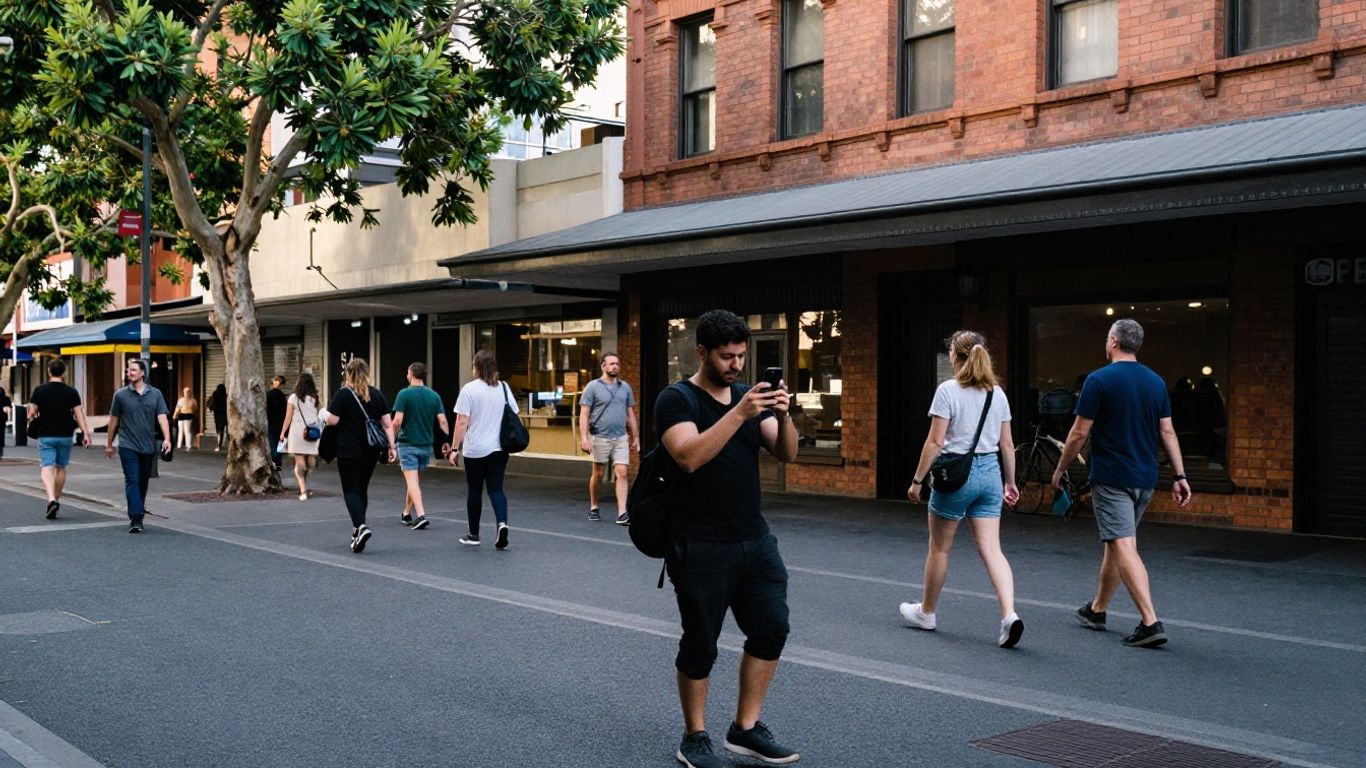
A smartphone can be a natural choice when you want to travel lightly through Australian streets or keep a camera close during an ordinary day. It is quick to raise, and you can review a frame immediately. A dedicated camera may feel more comfortable if you prefer physical controls or want to choose a lens, but it is worth practising with it before you rely on it in a fast-moving scene.
Choose the tool that lets you react without fumbling. Set up the camera app or camera controls in advance, keep the lens clean, and know how to focus and take a picture without looking down for long. If the device feels awkward, a quieter moment at home is a good place to practise.
Selecting lenses for close or distant moments
With a phone, its built-in camera options can cover a range of views, but moving your feet is often the simplest way to change a composition. With a camera, a wider lens can include more of a street or room, while a longer lens can help you frame a subject from farther away. Each perspective changes how much of the surrounding story remains visible.
Consider the distance you can comfortably keep, rather than choosing a lens only for reach. A wider view may suit a scene where the setting matters as much as the person. A longer view can simplify a busy background, but use it with care so you do not mistake distance for permission to ignore someone’s boundaries.
Using autofocus and burst mode effectively
Autofocus is useful when a person is moving unpredictably, but the camera still needs a clear subject to follow. If your device offers a continuous focus option, try it when people are walking or playing; for a still scene, a single focus may be easier to manage. Practise selecting the subject before you are in the middle of an important interaction.
Burst mode can help when a gesture changes quickly, such as a laugh or a passing cyclist entering the frame. It can also leave you with many near-identical pictures to sort through later. Use short bursts with a clear reason, then return to watching the scene instead of holding the shutter down continuously.
Setting shutter speed, aperture, and ISO
If you use a camera with manual controls, think first about how much movement you want to keep sharp. A faster shutter speed can help freeze action, while a slower one can show movement but may blur a moving subject. Aperture affects depth of field, and ISO affects how sensitive the camera is to light, so changing one setting can influence the others.
The table below is a starting point, not a set of fixed rules. Conditions vary with the light, lens, subject, and camera, so check a test frame and adjust when you can.
| Situation | First setting to consider | What to watch for |
|---|---|---|
| A person walking quickly | Faster shutter speed | Keep the subject sharp without losing the gesture |
| A still moment in soft light | Wider aperture | Check that the important details remain in focus |
| A dim indoor scene | Higher ISO if needed | Watch for visible image noise |
| A bright outdoor scene | Lower ISO where practical | Preserve detail in bright areas |
For a phone, many exposure adjustments happen automatically, though you can often tap a subject to set focus or adjust brightness. Whatever you use, make a small change and review the result rather than chasing a technically perfect setting while the moment passes.
Anticipate moments and compose with intention
Good candid work often begins before the shutter is pressed. You learn to notice where people pause, how light moves through a place, and what interactions might unfold next. This is less about guessing exactly what someone will do than about being present long enough to recognise a promising possibility. Stay open to surprise, and let the scene guide your timing.
Observing people and predicting natural interactions
Watch for patterns rather than trying to predict an exact expression. People often repeat small routines: a friend leans in to hear over traffic, a barista reaches for a cup, or someone steps aside to let a pram pass. Once you recognise the rhythm, you can prepare your framing and wait for a gesture that says something about the moment.
On a street, notice how people relate to the place as well as to one another. A pause at a crossing, a turn towards a shop window, or a shared look can become a frame when the background and timing come together. Keep your attention broad enough to see what is approaching, not only what is already in front of you.
Using light, backgrounds, and framing
Look for light that helps separate your subject from the setting. Open shade can soften harsh daylight, while a bright window or a patch of sun can create a clear point of interest. In Australian cities, reflected light from pale walls or shopfronts can change quickly as clouds pass or the sun drops behind buildings.
A few simple checks can help you build a frame without overthinking it:
- Look for a background that does not compete with the main interaction.
- Notice whether strong light is falling across a face or drawing attention elsewhere.
- Leave room in the frame for a person to move or look into.
- Check the edges for distractions before taking another frame.
Use these as quick prompts, not a checklist you must complete before every photograph. When a fleeting expression arrives, take the picture; you can make a more careful adjustment if the scene continues.
Finding a useful shooting position without disrupting the scene
A good position lets you see the interaction while giving people room to carry on. You might stand near the edge of a public space, use a doorway as a frame, or wait across the street for a scene to settle. Small changes in height or angle can also remove distractions without requiring you to move close.
Avoid blocking a path or stepping into a private conversation just to improve the composition. If people begin reacting to your presence, shift your position or lower the camera. The aim is not to disappear at any cost; it is to make photographs without taking over the space.
Knowing when to wait and when to press the shutter
Waiting is useful when the light and setting are promising but the scene has not quite come together. Give people time to move naturally through the frame, and watch for a gesture that clarifies what you noticed. But do not wait so long for an imagined perfect instant that you miss the honest one already in front of you.
A practical rhythm is to prepare the frame, stay attentive, and take a picture when the moment feels complete. If nothing happens, move on. The ability to let a scene pass is part of making considered photographs, not a failure to capture enough.
Help people feel comfortable and respect their boundaries
Candid photography depends on trust, even when you are photographing people you do not know. Your manner, distance, and choice of moment all affect how your presence feels. Be alert to signs that someone would rather not be photographed, and do not treat a public setting as a reason to ignore their comfort. A respectful approach leaves room for both the photograph and the person.
Blending in without being intrusive
You do not need to act mysterious to be unobtrusive. Move calmly, avoid sudden approaches, and keep your equipment at a scale that suits the setting. When you are photographing a public scene, spend time observing before lifting the camera so your movements feel measured rather than abrupt.
If someone notices you, respond naturally. A brief smile or a simple explanation can reduce uncertainty; if they seem uncomfortable, stop photographing them and give them space. Being considerate matters more than preserving the appearance of an unnoticed shot.
Photographing friends, family, and children naturally
People close to you may relax when the camera is present, but constant direction can still make an ordinary afternoon feel like a session. Photograph the small transitions between activities: a conversation while preparing food, a game changing direction, or a quiet moment after everyone arrives. Keep the camera ready, then let people return to what they were doing.
With children, consider what they are comfortable with and follow the guidance of their parent or carer. Avoid pushing for a reaction or repeating an action just to get a picture. The most meaningful frame may be a concentration-filled pause rather than a face turned towards the lens.
Asking permission in public or private settings
The right approach depends on the place and the person. In a private home, ask the people who live there before photographing, and be clear about where the images might be shared. In public, a wider scene may include people in the background, but you can still choose not to make an individual the focus if they appear uneasy.
When a close portrait or a sensitive setting is involved, a direct, polite question is often the clearest option. Explain what you are making the photograph for, accept a refusal without arguing, and avoid sharing an image if someone asks you not to. A candid photograph does not need to come at the cost of someone’s comfort.
Handling sensitive moments with care
Some moments carry more weight than a passing street interaction. Grief, distress, conflict, or a personal difficulty can leave someone especially exposed. Before raising your camera, ask whether a picture is necessary and whether you would be comfortable with the same image being made of you.
If the photograph would turn a person’s hardship into spectacle, put the camera away. When you do make a sensitive image with appropriate permission, consider the context in which it may be seen and avoid edits or captions that change its meaning. Restraint can be a better choice than a photograph.
Adapt your approach to different settings
A camera-ready habit looks different at home, on a busy footpath, and at a family gathering. The light, pace, and expectations change from place to place, so take a moment to understand the setting before you begin. This is especially useful when you photograph Australian cities, where quiet laneways and crowded transport stops can sit only a few streets apart. Keep your approach flexible while holding on to the same basic respect for people.
Capturing everyday moments at home
Home offers familiar light and repeated routines, which makes it easier to anticipate what may happen next. Notice how a kitchen window lights the bench in the morning or where people tend to gather in the evening. You do not need to rearrange the room; a small shift in your own position may be enough to make the scene clearer.
Include details that help the photographs feel connected to that particular home. A favourite chair, a half-finished craft project, or the way a shared meal is prepared can give the image context. Ask before photographing private spaces, and give people the option to carry on without being photographed.
Photographing candid street scenes
On the street, movement and background can change in a moment. Find a place where you can pause without blocking anyone, then observe the way pedestrians, traffic, and light move through the frame. If you see a compelling patch of light or an interesting doorway, you can wait for a natural interaction to pass through it rather than chasing every subject.
Keep your attention on the whole scene, including what is happening at the edges. A bus arriving, a shadow crossing the pavement, or a person turning towards a friend may all shift the composition. If the setting becomes crowded or someone appears uneasy, give them room and move on.
Working at events and family gatherings
Events bring people together, but they also come with expectations about photographs. Ask the host whether there are particular moments or people you should avoid photographing, and pay attention to any requests made during the gathering. If an event has an official photographer or a programme to follow, be mindful of their space and the attention guests are already giving the camera.
Look beyond the obvious group picture. Conversations before a meal, a helping hand with coats, or people listening to a story can show how the gathering feels. Take a few frames when the interaction is happening, then let guests return to it without asking them to repeat the moment.
Adjusting to low light and fast-moving scenes
Dim rooms and quick movement are a challenging combination. With a camera, you may need to use a faster shutter speed and accept a higher ISO to keep the action clear. With a phone, hold it steadily, look for available light near a window or doorway, and avoid relying on digital zoom if it makes the image look soft.
When the scene moves quickly, simplify your decisions. Focus on one person or gesture, make a few frames, and check whether the result is usable when there is a natural pause. A little blur can suit a lively scene, but if the important expression disappears, adjust your position or settings for the next opportunity.
Edit and select images while preserving authenticity
Editing is part of deciding how a photograph will be seen, not a reason to make the moment look different from what happened. Start by choosing images that show the interaction clearly and retain enough context to make sense. Then make modest adjustments that help the viewer see what you saw. A consistent, restrained approach often makes a set of candid photographs feel more coherent.
Choosing frames that best tell the story
When several frames show nearly the same moment, compare expression, gesture, and background rather than keeping every version. Look for the image that communicates the interaction without an awkward distraction or a confusing crop. A technically imperfect frame may still be the strongest if it holds the most revealing instant.
Consider how the photographs work as a group, too. A wider scene can establish a place, while a closer image may show a gesture or expression. Choosing both can create a small narrative, as long as each picture adds something rather than repeating the same information.
Correcting exposure, color, and contrast
Begin with small changes to exposure so important details are visible without making the scene unnaturally bright. Adjust colour gently, especially under mixed indoor lighting, where skin tones and surroundings can shift in different directions. A moderate contrast adjustment may help, but deep shadows and clipped highlights can remove details that were part of the atmosphere.
If you are unsure, compare the edit with the original and ask whether the light still feels like the light you remember. A crowded street at dusk need not look like midday to be clear. Aim to improve the photograph while keeping its mood intact.
Cropping without losing context
Cropping can guide attention towards a face or gesture, but removing too much can make an interaction hard to understand. Keep enough of the surroundings to show where people are and how they relate to the place. Check the edges after cropping; an accidental sliver of an object can be more distracting than the wider frame was.
Try a few versions before deciding, particularly if the image includes movement or a line of sight. Leave breathing room in front of a person who is walking or looking across the frame. If the crop feels cramped, the original composition may tell the story better.
Keeping edits natural and true to the moment
Avoid changes that add, remove, or reshape details in a way that alters what happened. Strong filters can also make a fleeting scene feel more dramatic or polished than it was. If you want a consistent look, use light adjustments across the set rather than forcing every photograph into the same heavy treatment.
A useful final check is to pause after editing and view the image again later. If it still feels like the scene you experienced, the edit is probably doing its job. Let the photograph remain a record of an imperfect, specific moment, rather than an attempt to make ordinary life look staged.
Conclusion
Candid photography grows from attention: to people, light, movement, and the boundaries that make a scene comfortable for everyone. Keep your equipment simple, prepare without overplanning, and give moments room to unfold. With practice, you can make photographs that feel considered without losing the honest character of what happened.